








-


-


-


Online Message


Do a factory's quality records matter as much as its certificates for imported i
2026-11-03
Share to:


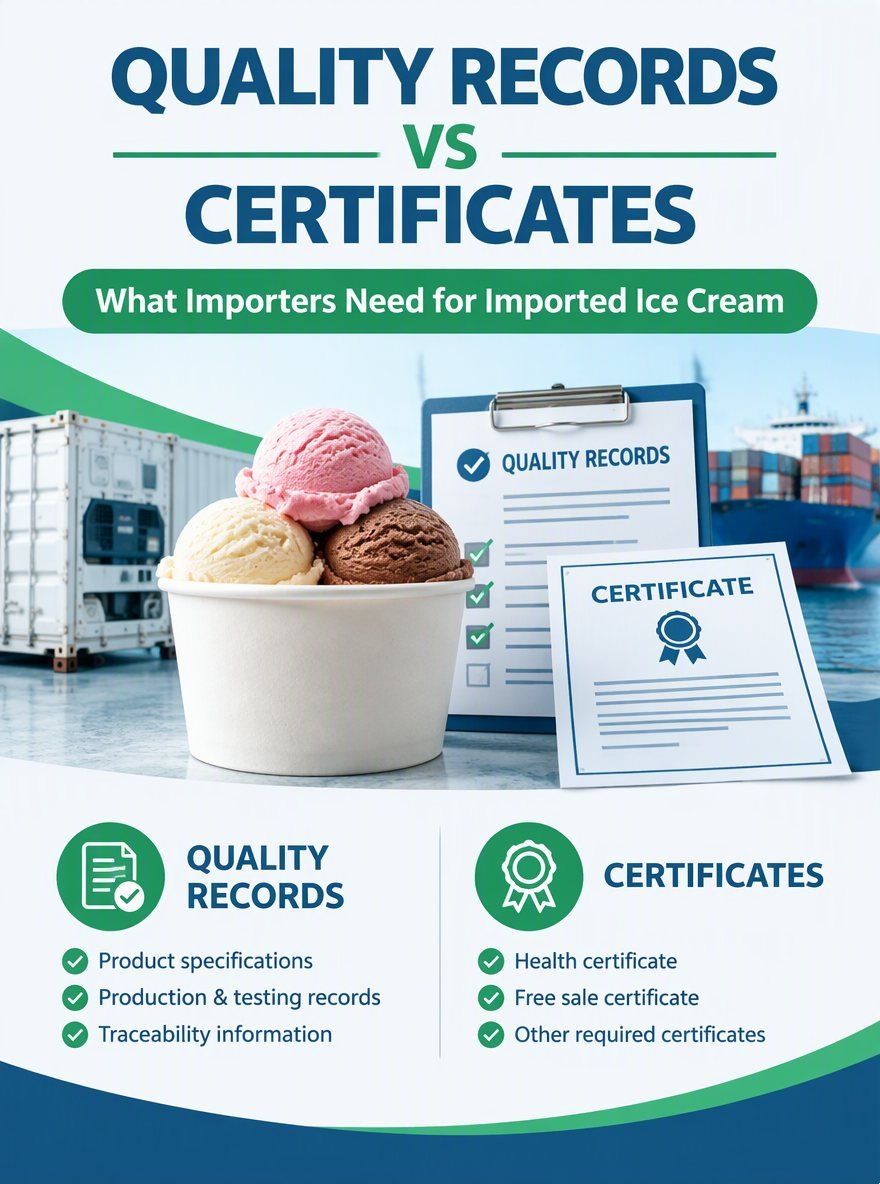
When importing frozen desserts, procurement teams often collect a standard folder of certificates before placing an order. ISO 22000, FDA facility registration, and Halal documentation are treated as mandatory prerequisites. Yet, when containers arrive at the destination port or undergo internal quality audits, paperwork gaps frequently trigger clearance delays. Importers frequently ask whether factory quality records matter just as much as static certificates for imported ice cream.
Why Certificates Alone Fall Short at Customs
Certificates prove that a manufacturing system exists and has been evaluated by an independent body. However, they do not verify what happened during a specific production run.
A certificate confirms that a facility maintains a quality management framework, but it does not accompany a specific bill of lading with per-batch proof. When customs or a major retail chain audits a shipment, they check whether the actual goods comply with food safety standards. If batch-level test results are missing, even a valid factory-level certificate leaves a compliance gap that can prolong a port hold. For cold chain shipments, prolonged holds increase electricity costs and the risk of temperature fluctuations.
What Batch Records Prove That Paperwork Cannot
Batch records bridge the gap between systemic capability and physical execution. Comprehensive quality control covers key operational stages: raw material inspection, in-process control, metal detection, microbiological testing, batch traceability, and final release.
| Document Type | What It Shows | When It Is Used |
|---|---|---|
| Factory Certificates (e.g., ISO 22000, FDA) | Systemic capability and compliance frameworks | Supplier onboarding and initial qualification |
| Batch Quality Records (e.g., test logs, release sheets) | Specific execution for individual shipment lots | Customs clearance, retail audit, and traceability |
Without batch records, importers cannot verify whether metal detection or microbiological testing was actually executed for the specific boxes in the container.
How Importers Should Request and Verify Both
For procurement and quality assurance teams managing imported ice cream, relying on either certificates or records in isolation introduces operational risk.
- Request them as a set: During the quotation and sampling stages, specify that batch-level release documents must accompany the shipping paperwork.
- Trace lot numbers: Ensure that the lot numbers on product packaging match the test reports issued by the factory's quality department.
- Protect the cold chain: Expediting document verification prevents unnecessary port delays while reefers require continuous power.
By treating certificates and quality records as equal prerequisites, importers protect their supply chain from unexpected compliance friction.
Authored by the regulatory and sales team at Hicey. Under Beijing Youshare Food Co., Ltd., we support global private label programs with three distinct compliance baselines: FDA registration for North America, HALAL certification for the Middle East, and ISO22000 management.
#Tags #ImportedIceCream #SupplyChainManagement #QualityControl #B2BProcurement
备选标题(按发布位置选用)
- 小红书:Do a factory's quality records matter as much as its certificates for imported ice cream?
- 抖音:Quality records versus certificates for frozen dessert suppliers
Product super fit, quick contact unlock exclusive program


looking for more infermatien?
Tel+Whatsapp:
Address: Yard 8, Fuze Road ,Fangshan District.Beijing, China
610 Zhonghai International Plaza, LicangDistrict, Qingdao, Shandong, China